



eLearning Phase Implementation Checker
Why This Matters
Skipping any phase leads to ineffective courses. This tool checks if you're properly implementing all 5 phases for maximum impact.
Your Current Status
The more phases you complete, the more effective your eLearning will be
Key Insight
Analysis is the most critical phase — skipping it means you're building without understanding your learners' needs.
"Without analysis, you're just guessing. You can build the prettiest course in the world, but if you don't know who your learners are or what they need, it won't work."
Select Your Current Phase
Select a phase to see details
Click on any phase button above to learn what's critical for that step
Your eLearning Implementation Report
Phase Completion Summary
Ever wonder why some online courses just click - and others fall flat? It’s not just about the video quality or the fancy platform. The real difference comes down to how the course was built. There’s a proven structure behind every successful eLearning program, and it breaks down into five clear phases. These aren’t just steps. They’re the backbone of effective online learning.
Analysis: Know Your Audience and Goals
Before you write a single line of content or record a single video, you need to ask: Who is this for? And what should they be able to do after finishing?
This is where most courses fail. People jump straight into designing slides or recording lectures without understanding the learners’ starting point. Are they new employees with zero experience? High school students struggling with math? Busy parents trying to upskill after work?
Good analysis means digging into real data. Look at past course completion rates. Survey learners. Talk to managers who see the skill gaps firsthand. For example, if you’re building a cybersecurity course for retail staff, you don’t need to teach them how to write Python scripts. You need to teach them how to spot phishing emails and report suspicious links. That’s the gap. That’s the target.
This phase also defines success. What does ‘learning’ look like here? Is it passing a quiz? Completing a simulation? Submitting a real-world task? Without this, you can’t measure if the course worked.
Design: Map Out the Learning Journey
Now that you know who you’re teaching and what they need to achieve, it’s time to plan the path. Design is where you turn goals into structure.
This isn’t about picking colors or fonts. It’s about sequencing. What should learners do first? What builds on that? How do you keep them engaged without overwhelming them?
Think of it like building a road. You don’t start with the asphalt. You lay the foundation, then the lanes, then the signs. In eLearning, that means:
- Breaking big topics into small chunks (microlearning)
- Using real scenarios instead of abstract theory
- Adding interactive checks - not just multiple-choice quizzes, but drag-and-drop exercises, branching simulations, or peer reviews
- Planning for different learning styles: some people learn by doing, others by watching, others by reading
For example, a sales training course might start with a video of a bad customer call, then ask learners to identify what went wrong. Next, they watch a good call. Then they practice their own version using a role-play tool. Each step builds on the last. No jumps. No gaps.
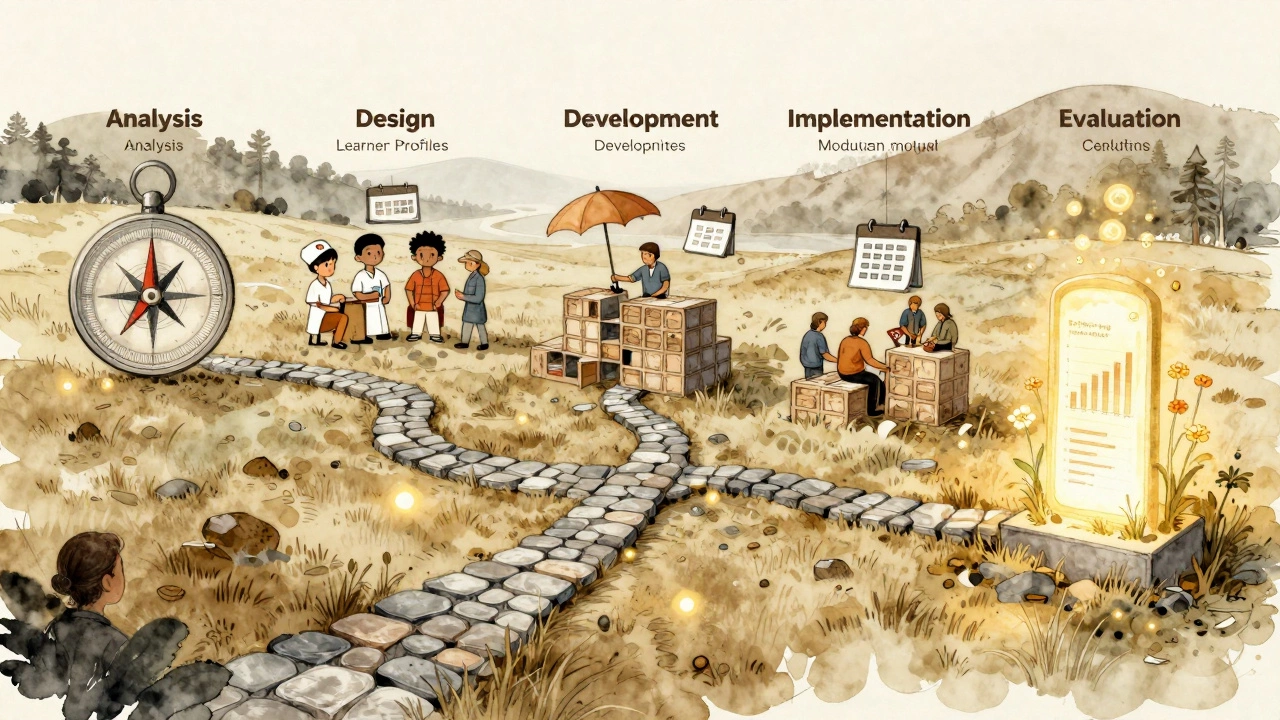
Development: Build the Actual Content
This is where the rubber meets the road. You’ve planned it. Now you build it.
Development means creating the actual materials: videos, PDFs, interactive modules, quizzes, discussion prompts. But here’s the key - it’s not about making everything look fancy. It’s about making everything work.
Use tools that match your audience’s tech level. If you’re training older workers, don’t force them through a complex LMS with 10 menus. Use simple, mobile-friendly content. If you’re teaching coders, you can use interactive coding sandboxes.
Also, test your content as you go. Record a 3-minute video. Show it to five people from your target group. Ask: Did they get it? Did anything confuse them? Did they stop watching? Fix it before you spend weeks building the rest.
And don’t forget accessibility. Text needs to be readable. Videos need captions. Buttons need to work with keyboard navigation. If you skip this, you’re excluding real people.
Implementation: Roll It Out and Support Learners
Time to launch. But launching doesn’t mean hitting ‘publish’ and walking away.
Implementation is about making sure learners actually start and finish. That means:
- Clear instructions on how to access the course
- Getting managers to encourage participation (not just send a link)
- Offering tech help - a chatbot, email support, or a quick-start guide
- Scheduling reminders (but not spammy ones)
Take a company that rolled out a new compliance course. They sent an email with a link and expected 90% completion. Only 42% finished. Why? Because people didn’t know when to do it. They didn’t know how long it would take. And no one checked in.
They fixed it by adding a calendar invite, a 2-minute video walkthrough, and a manager follow-up after 3 days. Completion jumped to 87%.
Support doesn’t stop at launch. Keep the door open. Answer questions. Update content if policies change. Learning isn’t a one-time event - it’s an ongoing process.

Evaluation: Did It Actually Work?
This is the phase most people skip. They assume if learners clicked through, they learned. That’s not true.
Evaluation means measuring real change. Not just test scores - actual behavior. Did the nurses start washing hands more often after the infection control course? Did the customer service team reduce complaint calls? Did students apply the formula in their next project?
Use a mix of methods:
- Immediate feedback: Short surveys right after the course
- Knowledge checks: Quizzes or practical tasks a week later
- Observation: Managers report on changes in performance
- Long-term tracking: Are skills still in use after 3 months?
One school district used this approach after rolling out a digital literacy course for teachers. They tracked how often teachers used new tools in their lesson plans. Three months later, 73% were using at least two new digital tools weekly. That’s impact.
Don’t just collect data. Use it. If only 30% of learners passed the final quiz, go back to the design phase. Maybe the content was too dense. Maybe the examples didn’t connect. Fix it. Then try again.
Why This Matters - And What Happens Without It
Skipping any of these five phases is like building a house without a blueprint. You might end up with something that stands - but it’ll be messy, inefficient, and full of hidden flaws.
Companies waste millions every year on eLearning that doesn’t stick. Employees forget it. Managers don’t see results. Learners feel like they’ve just been handed another checkbox.
But when you follow these five phases - analysis, design, development, implementation, evaluation - you create learning that lasts. You don’t just deliver content. You change behavior. You solve real problems.
It’s not magic. It’s method. And it works - whether you’re training 10 people or 10,000.
What’s the most important phase in eLearning?
There’s no single ‘most important’ phase - they all depend on each other. But if you skip analysis, everything after it will be misaligned. You can build the prettiest course in the world, but if you don’t know who your learners are or what they need, it won’t work. Analysis sets the direction. Without it, you’re just guessing.
Can I skip the evaluation phase if learners seem happy?
No. Happiness doesn’t equal learning. Learners might enjoy a course because it’s short or funny, but that doesn’t mean they retained anything. A survey saying ‘I liked this’ tells you nothing about whether they can actually apply the skill. Real evaluation looks at behavior change - not just opinions. Skip this, and you’re flying blind next time.
Do I need special software for each phase?
Not at all. You can do analysis with surveys and interviews. Design with paper sketches or Google Docs. Development can be done with free tools like Canva, OBS, or H5P. Implementation just needs an LMS or even a shared drive. Evaluation can be as simple as asking managers for feedback. You don’t need expensive platforms - you need a clear process.
How long should each phase take?
There’s no fixed timeline. A 10-minute microcourse might take 2 weeks total. A 6-month certification program could take 6 months just for analysis and design. The rule is: spend more time up front. The better your analysis and design, the faster and smoother development becomes. Rushing early always costs more later.
Is this only for corporate training?
No. This five-phase model works for schools, nonprofits, government programs, and even personal learning projects. Whether you’re teaching kids how to use a library database or helping retirees learn online banking, the same logic applies: know your learner, plan the path, build it well, support them through it, and check if it worked.