

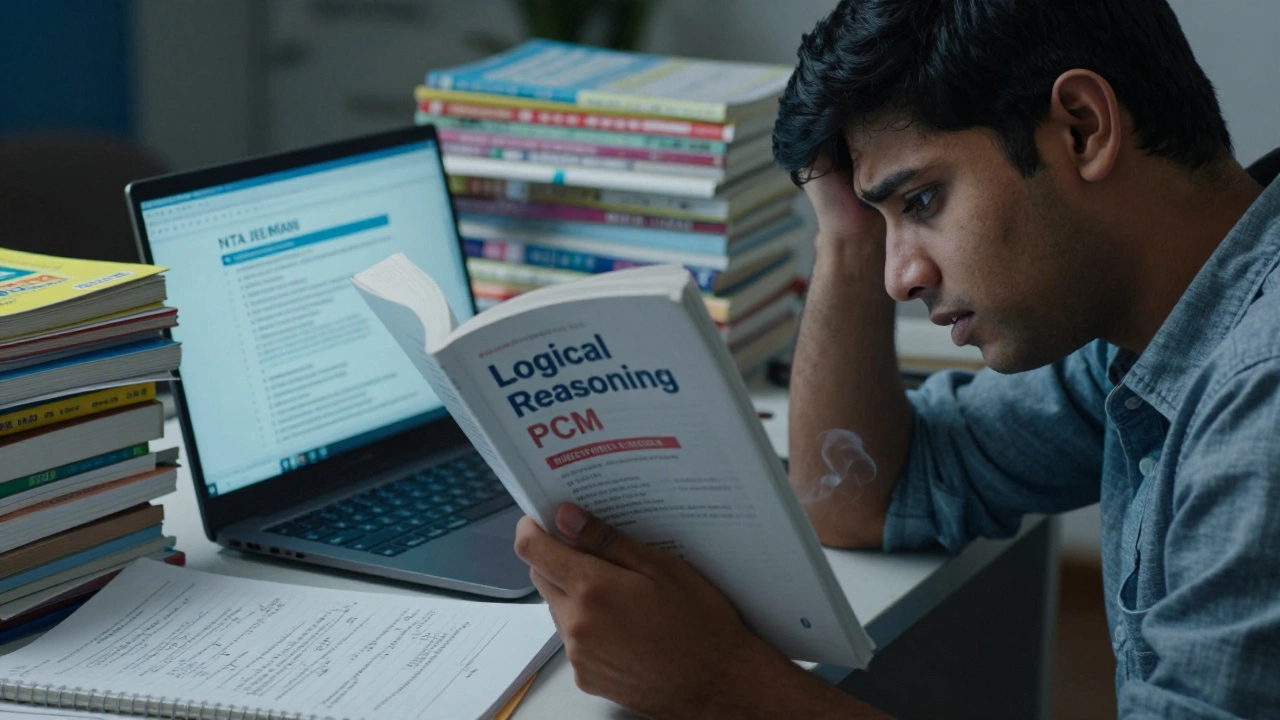
JEE Main Mental Ability Strategy Planner
Your Target Parameters
Speed Analysis
Personalized Mental Ability Training Plan
Ready to Optimize Your Strategy?
Enter your parameters above to discover how to train your "hidden" mental ability for JEE Main.
Here is the short answer that saves you hours of panic: No. JEE Main is the national-level engineering entrance examination conducted by the National Testing Agency (NTA) for admission to IITs, NITs, and other central government-funded technical institutions. There is no separate "Mental Ability" or "Logical Reasoning" section in the exam paper. You will not see questions labeled as such.
However, if you think this means you can ignore your brain's processing speed and logic, you are making a dangerous mistake. While the label is gone, the skill is deeply embedded in every single question you face. Understanding this distinction is the difference between scoring an average rank and cracking the top percentile.
The Official Syllabus vs. The Hidden Curriculum
To understand why mental ability matters even when it isn't listed, we have to look at what NTA is the National Testing Agency, an autonomous body under the Ministry of Education, Government of India, responsible for conducting various high-stakes examinations including JEE Main and NEET. actually tests. The official syllabus for JEE Main covers three subjects: Physics, Chemistry, and Mathematics. That’s it. If you download the latest syllabus document from the official website, you will find zero mention of "General Aptitude" or "Verbal Reasoning."
This stands in stark contrast to exams like NATA is the National Aptitude Test in Architecture, which explicitly includes a Drawing and General Aptitude section testing spatial ability, logical reasoning, and observation skills. or JEE Advanced is the second stage of the Joint Entrance Examination, known for its extreme difficulty and multi-concept questions that require deep analytical thinking rather than rote memorization. Even JEE Advanced doesn't have a dedicated reasoning section, but its questions often require complex logical deduction that feels like a reasoning test disguised as physics.
In JEE Main, the "mental ability" component is hidden inside the standard problems. When you solve a complex integration problem, you aren't just applying a formula; you are using logical steps to decide which method works best. When you analyze a circuit diagram in Physics, you are using spatial reasoning. The exam tests your ability to think clearly under pressure, which is the core definition of mental ability.
Where Logical Reasoning Hides in JEE Main
If you want to train your "mental muscles" for JEE Main, you need to know where they are exercised. Here is how logical reasoning manifests in the three core subjects:
- Mathematics: This subject has the highest overlap with logical reasoning. Topics like Probability is a branch of mathematics concerning numerical descriptions of how likely an event is to occur or how certain we are that a proposition is true, Permutations and Combinations are mathematical techniques for counting the number of ways events can happen without listing them all, and Sequence and Series are ordered lists of numbers following specific patterns used to calculate sums and limits require pure logical deduction. You cannot guess your way through these. You must follow a strict chain of logic.
- Physics: Many Physics questions are conceptual. For example, questions on Modern Physics is physics developed after classical physics, encompassing quantum mechanics and relativity theory often involve interpreting graphs and understanding cause-and-effect relationships rather than heavy calculation. This tests your ability to reason through abstract concepts quickly.
- Chemistry: Inorganic Chemistry relies heavily on trends and exceptions. Understanding why an element behaves a certain way requires logical inference based on periodic properties. Organic Chemistry reaction mechanisms are essentially flowcharts of electron movement-pure logic applied to chemistry.
Why Speed and Accuracy Are Your New "Mental Ability" Test
The real "aptitude" test in JEE Main is time management. You have 3 hours to solve 75 questions (attempting around 60-65). This translates to roughly 1 minute per question. This constraint forces you to develop heuristics-mental shortcuts-that are essentially advanced logical reasoning skills.
Consider this scenario: You encounter a multiple-choice question with four options. A student with strong mental agility might use the "elimination method" or "dimensional analysis" to rule out two obviously wrong answers instantly. This isn't cheating; it's efficient thinking. It’s the same skill set tested in traditional aptitude tests, but applied to scientific principles.
For instance, in a Physics question about units, if the question asks for velocity but two options have units of force, you eliminate them immediately. This split-second decision-making process is pure mental ability. Students who practice these shortcuts score higher not because they know more formulas, but because their brains process information more efficiently.
Common Misconceptions About JEE Main Pattern
Confusion often arises because students mix up different engineering entrance exams. Let’s clear the air with a comparison table.
| Exam Name | Conducting Body | Has Dedicated Mental Ability Section? | Primary Focus |
|---|---|---|---|
| JEE Main | NTA | No | Physics, Chemistry, Mathematics (Technical Knowledge) |
| NATA | Council of Architecture | Yes | Drawing, Spatial Ability, Logical Reasoning |
| BITSAT | Birla Institute of Technology | Yes (General Aptitude) | Physics, Chemistry, Math, English Proficiency, Logical Reasoning |
| VITEEE | VIT University | No | Physics, Chemistry, Mathematics, Aptitude (sometimes integrated) |
Note that BITSAT is the Birla Institute of Technology and Science Admission Test, which includes a specific section for General Aptitude covering logical and quantitative reasoning. If you are preparing for BITSAT alongside JEE Main, do not neglect the reasoning section. But for JEE Main alone, focus your energy on mastering the core subjects while sharpening your speed.
How to Train "Hidden" Mental Ability for JEE
Since there is no separate section, how do you prepare? You don't buy a "Logical Reasoning for JEE" book. Instead, integrate these strategies into your daily study routine:
- Solve Previous Year Questions (PYQs): Analyze past papers from 2020 to 2025. Notice patterns in how questions are framed. Often, the trickiest questions reward those who can spot the simplest path. This trains your pattern recognition-a key mental ability skill.
- Practice Mock Tests Under Timed Conditions: Never solve a chapter-wise test without a timer. Force yourself to make decisions quickly. If you get stuck for more than 90 seconds, mark it and move on. This builds the discipline to skip difficult problems, a crucial strategic skill.
- Focus on Conceptual Clarity: Rote learning fails when questions are twisted. True understanding allows you to derive answers logically. For example, instead of memorizing every chemical reaction, understand the mechanism. This makes you adaptable to new, unseen questions.
- Use Elimination Techniques: Practice identifying incorrect options first. In Mathematics, check boundary values. In Physics, check dimensional consistency. This turns a hard problem into an easy one.

The Role of Stress Management
Mental ability isn't just about IQ; it's about emotional regulation. On exam day, your heart rate will spike. Adrenaline will flood your system. Students who panic lose access to their working memory. They forget basic formulas they knew cold last week.
Training your mind to stay calm is part of preparation. Techniques like box breathing or progressive muscle relaxation before starting the exam can help reset your cognitive state. A calm mind processes information faster and makes fewer silly errors. In a high-stakes exam like JEE Main, avoiding negative marking due to careless mistakes is often more valuable than solving one extra tough problem.
Final Verdict for 2026 Aspirants
As we move through 2026, the structure of JEE Main remains stable regarding its content. There are no rumors or official notifications suggesting the addition of a standalone Mental Ability section. The NTA continues to emphasize depth in PCM (Physics, Chemistry, Mathematics).
Your strategy should be simple: Master the syllabus deeply, practice speed relentlessly, and trust your logic. Don't waste time searching for a "reasoning section" that doesn't exist. Instead, become the student who can look at a complex problem, break it down logically, and solve it efficiently. That is the true essence of mental ability in JEE Main.
Is there a General Aptitude section in JEE Main 2026?
No, there is no General Aptitude or Mental Ability section in JEE Main 2026. The exam consists solely of Physics, Chemistry, and Mathematics. Any source claiming otherwise is likely confusing JEE Main with other exams like BITSAT or NATA.
Do I need to study Logical Reasoning for JEE Main?
You do not need to study Logical Reasoning as a separate subject. However, you should practice logical thinking within the context of Physics, Chemistry, and Mathematics. Skills like elimination, dimensional analysis, and pattern recognition are vital for speed and accuracy.
Which engineering entrance exams include Mental Ability?
Exams like BITSAT (Birla Institute of Technology and Science Admission Test), NATA (National Aptitude Test in Architecture), and some university-specific tests like VITEEE may include sections on General Aptitude, Logical Reasoning, or Spatial Ability. Always check the specific syllabus for each exam.
How does JEE Main differ from JEE Advanced in terms of question style?
JEE Main focuses on breadth and speed, covering a wide range of topics with straightforward applications. JEE Advanced focuses on depth and complexity, often requiring multi-step logical deductions and combining concepts from different chapters. While neither has a dedicated reasoning section, JEE Advanced demands higher-order analytical thinking.
Can improving my mental speed help me in JEE Main?
Absolutely. Since you have limited time (3 hours) to attempt a large number of questions, mental agility helps you identify the quickest solution path. Practicing timed mock tests and learning shortcut methods can significantly improve your ranking by allowing you to attempt more questions correctly.