



America's Toughest Exam Comparator
Select two exams below to see a side-by-side breakdown of their specific challenges based on article data.
The Bar Exam
Law LicensureEndurance test with complex legal reasoning under extreme time pressure.
The MCAT
Med School EntryBroad scope covering sciences, social sciences, and critical reading (CARS).
USMLE Step 1 & 2
Medical LicensureMassive volume of medical knowledge required for clinical application.
CPA Exam
AccountingTechnical depth in auditing, regulation, and financial accounting.
LSAT
Law School EntryPure logic puzzles designed to trick you; no vocabulary memorization.
Based on data from "What Is America's Toughest Exam?"
| Metric | Exam 1 | Exam 2 |
|---|---|---|
| Primary Difficulty Factor | - | - |
| Total Duration | - | - |
| Typical Study Time | - | - |
| Key Challenge | - | - |
| Pass Rate / Score Pressure | - | - |
Difficulty Intensity
Difficulty Intensity
The Verdict
Select exams to generate verdict.
There is no single "hardest" test in the United States because difficulty depends entirely on what you are trying to do. If you want to practice law, the Bar Exam is the gatekeeper. If you want to become a doctor, the USMLE (United States Medical Licensing Examination) or MCAT (Medical College Admission Test) will break your spirit first. These aren't just quizzes; they are high-stakes hurdles that determine your career trajectory.
When people ask about America's toughest exam, they usually mean one of three things: the lowest pass rate, the highest volume of material, or the most psychological pressure. The reality is that each of these major exams attacks you from a different angle. Let’s look at the contenders for the title of the most difficult standardized test in the country.
The Bar Exam: The Law Student’s Final Boss
If you have spent three years in law school, the Multistate Bar Examination (MBE) is likely the scariest thing you can imagine. It is not just a test of memory; it is a test of endurance and legal reasoning under extreme time pressure.
The Bar Exam varies by state, but the MBE portion is consistent across jurisdictions. You face 200 multiple-choice questions in four hours. That gives you roughly 1.2 minutes per question. Each question presents a complex fact pattern involving contracts, torts, constitutional law, or criminal procedure. You don’t just need to know the law; you need to apply it instantly to a new scenario.
Why is it so hard? The pass rates tell the story. In some states like California, the pass rate hovers around 40-50%. In others, it might be higher, but the sheer volume of reading required to prepare is staggering. Candidates often study full-time for two to three months before the exam. You are expected to master the laws of multiple states simultaneously while maintaining the mental stamina to focus for nine hours straight on exam day.
- Format: Multiple choice (MBE), essays, and performance tests.
- Duration: Two days, totaling 9+ hours of testing.
- Average Pass Rate: Varies by state, typically 60-75% nationally, lower in competitive states.
- Key Challenge: Applying abstract legal principles to specific, nuanced facts quickly.
The MCAT: The Gatekeeper to Medical School
Before you even get to medical school, you have to survive the MCAT. This is arguably the most stressful exam for pre-med students because it determines whether you get into medical school at all. Unlike the Bar Exam, which tests professional competence after training, the MCAT tests your potential to learn medicine.
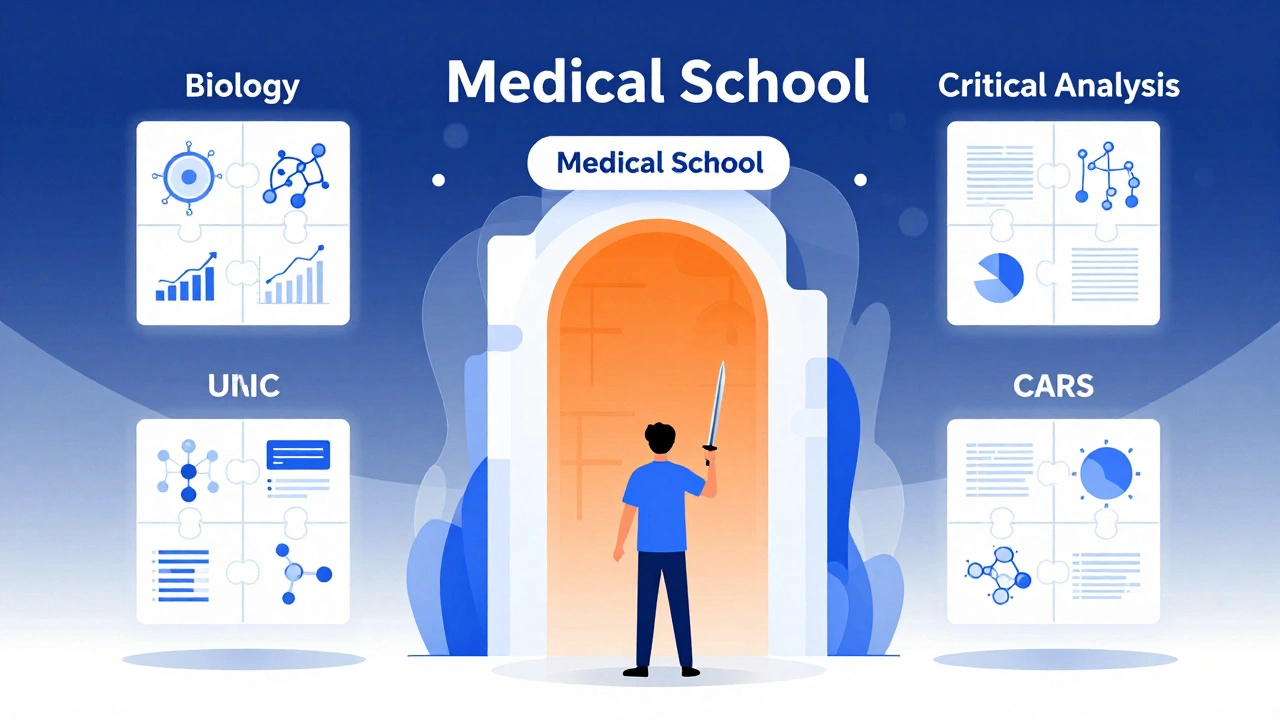
The MCAT covers biology, chemistry, physics, psychology, sociology, and critical analysis. But here is the catch: it doesn’t just ask you to recall facts. It asks you to interpret data from graphs, evaluate scientific arguments, and solve problems using concepts you may have only skimmed in college classes. The section on "Critical Analysis and Reasoning Skills" (CARS) is notorious for having no right answers based on science-it tests your ability to read dense, philosophical passages and infer meaning.
The score range is 472 to 528, with the average accepted student scoring around 511-512. To be competitive at top-tier schools, you often need a 517 or higher. That means getting nearly every question right. One bad day can cost you thousands of dollars in application fees and another year of life.
- Format: Four sections, mostly multiple-choice with data interpretation.
- Duration: Approximately 7.5 hours.
- Scoring: 472-528 total scale.
- Key Challenge: Integrating knowledge across disciplines and mastering the non-science CARS section.
The USMLE: The Doctor’s Marathon
If you think the MCAT is hard, wait until you meet the USMLE Step 1 and USMLE Step 2 CK. These are the exams medical students take during and after their clinical rotations. They are widely considered the most content-heavy exams in American education.
Step 1 covers basic sciences: anatomy, physiology, biochemistry, pathology, pharmacology, and microbiology. The volume of information is incomprehensible to outsiders. You are expected to know how every drug works, what every disease looks like under a microscope, and how every organ system interacts. For years, Step 1 was scored numerically, adding immense pressure. Since 2022, it has been pass/fail, which reduces stress slightly but does not reduce the amount of studying required.
Step 2 CK (Clinical Knowledge) is often considered harder because it applies that basic science to real patient care. You must diagnose patients, order correct tests, and choose treatments based on current guidelines. The stakes are high because residency programs use Step 2 scores to rank applicants. A low score can prevent you from becoming a surgeon or specialist.
- Format: Computer-based, multiple-choice questions with interactive elements.
- Duration: Step 1 is ~8 hours; Step 2 CK is ~9 hours.
- Pass Rates: Step 1 ~94% for U.S. MD seniors; Step 2 CK ~93%.
- Key Challenge: Retaining massive amounts of detailed medical knowledge and applying it clinically.
Other Contenders for the Hardest Title
While law and medicine dominate the conversation, other fields have brutal entry exams. The CPA Exam (Certified Public Accountant) is known for its breadth. You must pass four sections covering auditing, business environment, financial accounting, and regulation. Many candidates fail individual sections multiple times due to the dry, technical nature of the material.
For those interested in academia or graduate studies, the GRE (Graduate Record Examination) and LSAT (Law School Admission Test) are significant hurdles. The LSAT, in particular, is famous for its logical reasoning questions that feel like puzzles designed to trick you. There is no vocabulary list to memorize; you must master a specific type of logic that takes years to refine.
| Exam | Purpose | Duration | Primary Difficulty Factor | Typical Study Time |
|---|---|---|---|---|
| Bar Exam (MBE) | Licensure to practice law | 2 Days (9+ hrs) | Application of law under time pressure | 2-3 Months Full-Time |
| MCAT | Medical School Admission | ~7.5 Hours | Breadth of science + Critical Reading (CARS) | 3-6 Months Part-Time |
| USMLE Step 1 | Medical Licensure (Basic Science) | ~8 Hours | Volume of medical knowledge | 4-6 Months Dedicated |
| USMLE Step 2 CK | Medical Licensure (Clinical) | ~9 Hours | Clinical decision-making accuracy | 3-4 Months Dedicated |
| CPA Exam | Accounting Licensure | 4 Sections (6 hrs each) | Technical detail and retention | 6-12 Months Total |
Why Are These Exams So Hard?
The difficulty isn't accidental. These exams serve as quality control for professions where mistakes can cost lives, freedom, or millions of dollars. The Bar Exam ensures lawyers can protect clients' rights. The USMLE ensures doctors can diagnose diseases correctly. The MCAT filters for students who can handle the cognitive load of medical training.
Another factor is the "unknown." Unlike school exams where you know the textbook, these professional exams often include scenarios you have never seen before. You must rely on first principles and logic rather than rote memorization. This unpredictability creates anxiety, which further increases perceived difficulty.
How to Prepare for the Impossible
If you are facing one of these exams, panic won't help. Structure will. Here is how successful candidates approach these giants:
- Start Early: Do not cram. These exams require spaced repetition. Use tools like Anki flashcards to retain information over months, not weeks.
- Practice Under Real Conditions: Take full-length practice tests at the same time of day as the real exam. Build your stamina. If the exam is 7 hours long, you need to be able to sit still and focus for 7 hours.
- Analyze Every Mistake: Getting a question wrong is valuable data. Understand why you missed it. Was it a knowledge gap? A misreading of the prompt? A time management issue?
- Mental Health Matters: Burnout is the biggest enemy. Schedule breaks. Exercise. Sleep. A tired brain cannot perform complex reasoning tasks.
Remember, these exams are not measures of your worth. They are measures of your preparation. With the right strategy, even the toughest exams become manageable challenges.
Is the Bar Exam harder than the MCAT?
It depends on your strengths. The Bar Exam is generally longer and requires more sustained endurance over two days. It also has a lower national pass rate in many jurisdictions. However, the MCAT is broader in scope, covering sciences, social sciences, and critical reading. For someone strong in logic and law, the Bar may feel easier. For a science student, the MCAT might be more intuitive. Most professionals agree the Bar Exam feels more psychologically draining due to its length and high stakes for licensure.
What is the hardest part of the USMLE Step 1?
The hardest part of USMLE Step 1 is the sheer volume of information. You must memorize and understand thousands of facts about human biology, disease processes, and drug mechanisms. Even though it is now pass/fail, the amount of studying required is immense. Students often spend 4-6 months studying full-time just to ensure they pass. The challenge is retaining this information while staying mentally healthy.
How long does it take to prepare for the Bar Exam?
Most law graduates dedicate 2 to 3 months of full-time study to the Bar Exam. This involves attending a bar review course, completing hundreds of practice questions, and writing numerous essays. Some students start reviewing material earlier in their final year of law school, but the intensive "dedicated" period is typically 8-12 weeks.
Can I retake the MCAT if I don't get a good score?
Yes, you can retake the MCAT up to five times in a lifetime and seven times in a single year. However, medical schools see all your scores. A significantly lower score on a subsequent attempt can hurt your application. It is better to wait until you are fully prepared and have improved your study methods before retaking it.
Is the CPA Exam considered harder than the Bar Exam?
Many candidates find the CPA Exam challenging due to its technical depth and the need to pass four separate sections. However, the Bar Exam is often viewed as more difficult because of its length, the complexity of legal reasoning required, and the lower pass rates in certain states. The CPA Exam is more about memorizing rules and regulations, while the Bar Exam requires applying principles to novel situations.