





Competitive Mindset Assessment
Is your drive to win propelling you forward or holding you back? Take this quick assessment to discover your competitive profile.
Question text goes here?
Your Profile: Analyzing...
The Core Drivers: Why We Compete
At its simplest level, competitiveness comes down to how we view our own value. Most people fall into one of two categories: those driven by mastery and those driven by performance. Mastery-oriented people want to get better at a skill for the sake of the skill itself. Performance-oriented people, however, care more about how they look compared to the person next to them.
This often boils down to Achievement Motivation, which is the internal drive to excel and meet a high standard of success. In the context of competitive exams, this motivation is what keeps a student awake at 3 AM reviewing organic chemistry. They aren't just fighting the clock; they are fighting the possibility of being average. For these individuals, the 'win' provides a hit of dopamine that reinforces the behavior, creating a loop where the more they succeed, the more they crave the next victory.
The Role of Social Comparison
We don't determine our success in a vacuum. We use something called Social Comparison Theory to figure out where we stand. Developed by Leon Festinger in 1954, this theory suggests we have an innate drive to evaluate ourselves by comparing our abilities to others.
There are two ways this happens: upward and downward comparison. Upward comparison is when you look at the top scorer in your coaching center and feel a mix of admiration and envy. This can be a powerful fuel if it inspires you to work harder. However, if the gap feels too wide, it can lead to anxiety and a feeling of inadequacy. Downward comparison is when you look at those struggling more than you to boost your own ego. While this provides a temporary confidence lift, it rarely leads to actual growth because it removes the pressure to improve.
| Trait | Healthy Competitiveness | Maladaptive Competitiveness |
|---|---|---|
| Focus | Self-improvement & growth | Beating others at any cost |
| Reaction to Failure | Analyzes mistakes to improve | Feels shame or personal attack |
| View of Peers | Collaborators/Benchmarks | Threats/Enemies |
| Motivation | Intrinsic (Love for the goal) | Extrinsic (Status/Praise) |

The Brain and Biology of the Win
It is not all in your head; it is in your chemistry. When you win a competition or score higher than your peers, your brain releases Dopamine, a neurotransmitter associated with pleasure and reward. This creates a biological reward system. For highly competitive people, this reward is more potent. They become 'addicted' to the feeling of superiority.
Beyond dopamine, there is the role of Cortisol, the stress hormone. Competitive environments, like the final weeks before a government exam, spike cortisol levels. For some, this stress is paralyzing. For the 'competitive type,' a moderate amount of stress actually sharpens their focus. They enter a state of high arousal that allows them to process information faster and stay alert for longer periods. This is why some people actually perform better under pressure than they do in a relaxed setting.
Mindset Matters: Fixed vs. Growth
How you handle the competitive drive depends heavily on your mindset. Growth Mindset, a concept popularized by psychologist Carol Dweck, is the belief that abilities can be developed through dedication and hard work. Competitive people with a growth mindset see a rival's success as a roadmap. They think, 'If they can master this complex math problem, I can too.'
On the flip side, those with a Fixed Mindset believe their intelligence or talent is static. To them, competition is a scary trial of their inherent worth. If they lose, it doesn't mean they didn't study enough; it means they aren't 'smart enough.' This mindset turns competitive exams into an emotional minefield, where every wrong answer feels like a permanent stain on their identity.
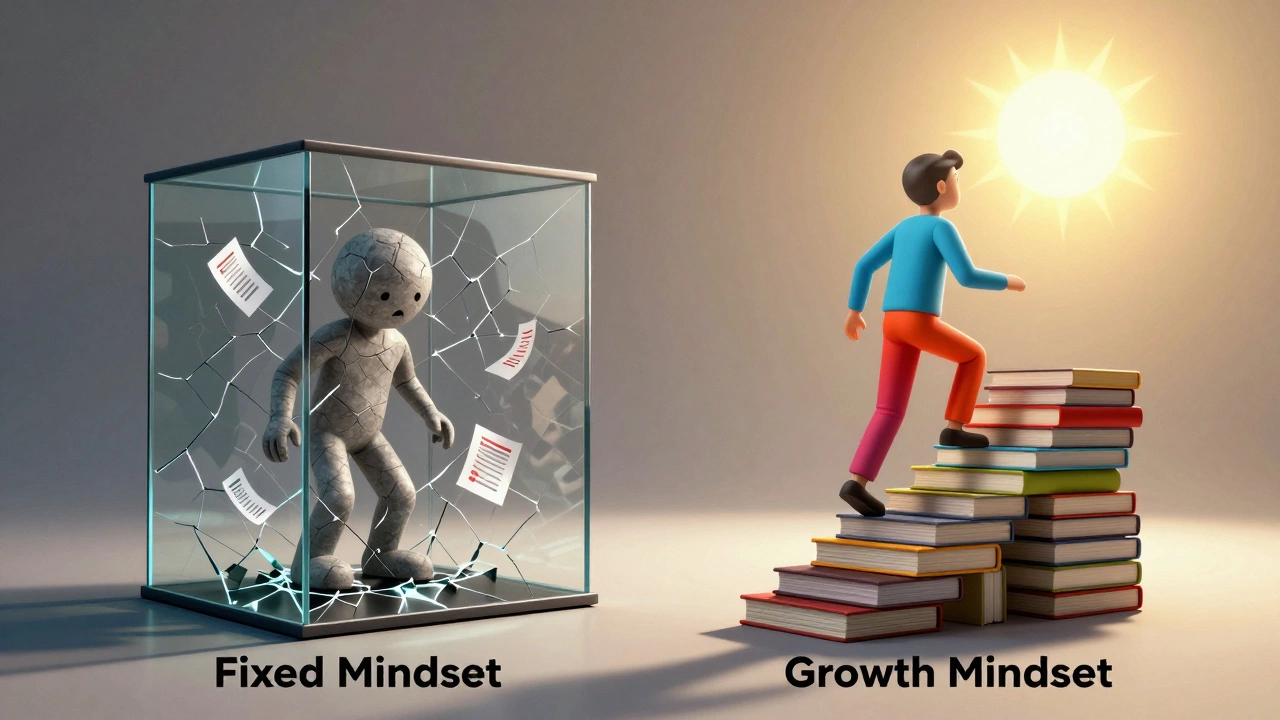
The Dark Side of the Drive
While the drive to win can propel you to the top of the IIT JEE or NEET rankings, it comes with a cost. When your self-worth is tied exclusively to being 'the best,' you are essentially handing your happiness over to other people. If someone else performs better, your value drops in your own eyes.
This often leads to 'imposter syndrome,' where even high achievers feel like frauds because they believe their success is a fluke or that they aren't as good as others perceive them. It can also lead to burnout. The 'grind culture' prevalent in competitive exam prep-where sleep is sacrificed and social lives are deleted-is a direct result of maladaptive competitiveness. When the goal is to outwork everyone else, the human body eventually hits a wall.
How to Channel Competitiveness Productively
The goal isn't to kill your competitive spirit-that's where your energy comes from. The goal is to shift the target of your competition. Instead of competing against the 100,000 other applicants, compete against your previous version.
- Track Personal Bests: Use a log to track your mock test scores. When you see your own trend line going up, you get the same dopamine hit as beating a peer, but without the toxic envy.
- Find a 'Study Buddy' Rivalry: Healthy competition thrives in pairs. Find someone at your level and challenge each other. This turns a lonely struggle into a social game.
- Diversify Your Identity: Don't be just 'the student.' Be a runner, a musician, or a gamer. When you have multiple sources of competence, a bad grade in one subject won't crash your entire sense of self.
- Focus on the Process, Not the Rank: Instead of obsessing over the final merit list, obsess over the daily habit. Winning the day is a more sustainable goal than winning the year.
Is being overly competitive a bad thing?
It depends on the source. If it stems from a desire for growth and excellence, it is a superpower. However, if it stems from a fear of failure or a need for external validation, it can lead to chronic stress, anxiety, and strained relationships. The key is whether you are running toward a goal or running away from a fear of being 'less than.'
Can you develop a competitive drive if you aren't naturally competitive?
Yes. Competitive drive can be cultivated by setting small, measurable goals and celebrating the wins. By creating a reward system for yourself-like treating yourself to a favorite meal after finishing a difficult chapter-you can train your brain to associate hard work and 'winning' with pleasure.
How does competitiveness affect mental health during exam prep?
It is a double-edged sword. In moderation, it provides the focus and resilience needed to handle an intense syllabus. In excess, it creates a high-pressure environment that can trigger burnout, insomnia, and depression. It is vital to balance the drive to win with self-care and a support system.
Why do some people enjoy competing more than others?
It's a mix of temperament and experience. Some people are born with a higher baseline of sensation-seeking behavior, meaning they crave the rush of a challenge. Others developed this trait through childhood experiences, such as being praised only when they won or having siblings who were high achievers.
What is the best way to deal with a hyper-competitive peer?
The best strategy is to 'de-couple' your progress from theirs. Acknowledge their drive but keep your focus on your own metrics. If they try to use their progress to diminish yours, remember that their competitiveness is often a mask for their own insecurity. Staying polite but focused on your own path is the most effective response.