



Global Math Performance Explorer
Select a metric below to see which countries lead in that specific area of mathematics. Note how the leaders change depending on whether we measure broad competence or elite potential.
PISA Scores
General application & reasoning (15-year-olds)
TIMSS Mastery
Curriculum mastery (Grades 4 & 8)
IMO Medals
Elite problem-solving (Top students)
Current Leader: Singapore (PISA)
You might assume the United States or China holds the crown for mathematical prowess. After all, they dominate university rankings and produce most Nobel laureates in physics. But when you look at raw student performance data from standardized global tests, a different picture emerges. The answer to "what country is #1 in math" depends entirely on which metric you trust: high school test scores or elite competition medals.
If we look at the PISA (Programme for International Student Assessment) results, which measure how well 15-year-olds apply math to real-world problems, Singapore consistently ranks as the top-performing nation. However, if you track the International Mathematical Olympiad (IMO), where the brightest pre-university students solve unsolved-style problems, countries like China, Russia, and Iran often trade places at the summit. Understanding this distinction is crucial for anyone studying abroad, hiring talent, or just curious about global educational trends.
The Data Behind the Rankings
To determine who is truly number one, we have to define what "good at math" means. There are two primary datasets used by educators and policymakers worldwide. One measures broad competence; the other measures peak potential.
The first dataset comes from the Organisation for Economic Co-operation and Development (OECD). Their PISA exams are taken every three years by students in over 80 countries. This test doesn't ask students to memorize formulas. Instead, it asks them to interpret data, model real-life scenarios, and reason logically. In the most recent cycles leading up to 2026, Singapore has maintained its position at the top with an average score exceeding 570 points, significantly higher than the OECD average of roughly 490. Other East Asian nations, including Macao, Hong Kong, and Japan, usually fill out the rest of the top five.
The second dataset is the International Mathematical Olympiad. This is not a test of average ability. It is a competition for the top 6 students selected from each participating country. Here, the dynamics change. China frequently wins the team title, securing gold medals in nearly every problem category. Russia and South Korea also perform exceptionally well. Unlike PISA, IMO success reflects the effectiveness of specialized training pipelines rather than general classroom instruction.
| Metric | Primary Focus | Top Performing Region | #1 Country (Recent Trends) |
|---|---|---|---|
| PISA Scores | Applied math skills for 15-year-olds | East Asia & Singapore | Singapore |
| International Mathematical Olympiad | Elite problem-solving capability | Asia & Eastern Europe | China / USA (varies by year) |
| TIMSS (Trends in Mathematics) | Curriculum mastery (Grades 4 & 8) | Singapore & East Asia | Singapore |
Why Singapore Leads General Education
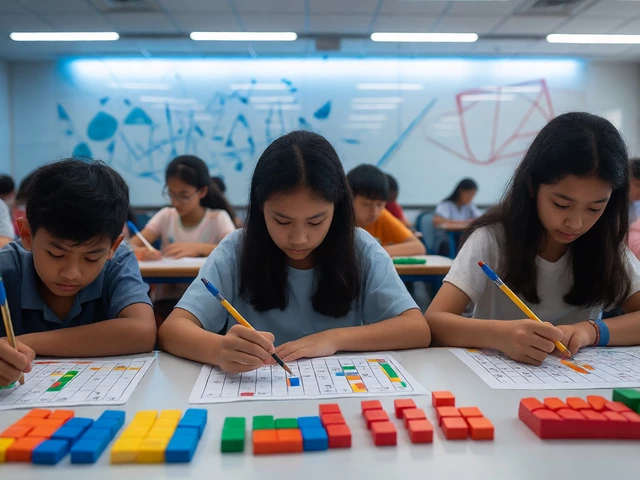
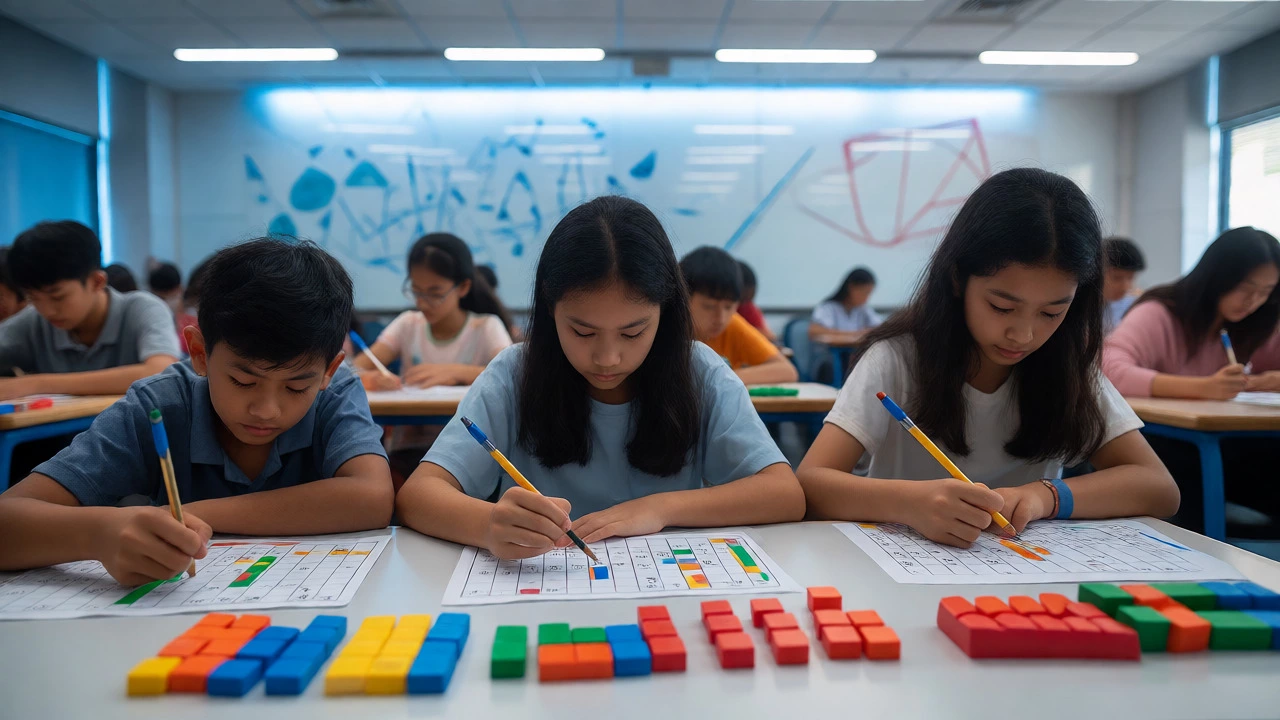
Why does a small island nation with no natural resources consistently outperform giants like India and the US in general math literacy? The answer lies in curriculum design and teacher training. Singapore’s approach, often called "Singapore Math," emphasizes concrete-pictorial-abstract learning. Students don't just learn that $2+2=4$; they use physical blocks to understand addition before moving to symbols.
This method builds deep conceptual understanding early on. By grade 4, students are tackling multi-step word problems that require logical deduction, not just calculation speed. Furthermore, Singapore invests heavily in its teachers. Educators spend significant time collaborating and refining lesson plans, ensuring that even average students grasp foundational concepts solidly. This creates a high floor for performance, meaning fewer students fall behind, which boosts national averages dramatically.
Other countries trying to replicate this success, such as the UK and parts of Australia, have adopted elements of the Singapore method. Yet, cultural emphasis on education and rigorous standardization play huge roles that are hard to copy overnight. If you are looking for a system that produces broadly competent mathematicians, Singapore remains the benchmark.

China and the Elite Competition Edge
If your definition of "best" involves solving problems that stump professional mathematicians, look toward China. The Chinese education system excels at identifying and nurturing talent through intense selection processes. From a young age, students who show aptitude enter specialized schools or participate in regional competitions. Those who excel move up to provincial teams, then national teams.
This funnel ensures that the six students sent to the IMO represent the absolute peak of mathematical intuition in a population of 1.4 billion. While PISA shows China performing well but not always #1 (due to sampling variations across provinces), their dominance in elite circles is undeniable. Russian students also feature prominently here, benefiting from a long tradition of Soviet-era math clubs and rigorous theoretical training.
It is worth noting that the United States performs surprisingly well in the IMO, often placing in the top three. American students benefit from diverse pathways, including private tutoring, online communities like Art of Problem Solving, and access to world-class universities. This suggests that while the US public school system may lag in average PISA scores, its elite pipeline is robust enough to compete globally.
Factors That Influence National Math Performance
Rankings aren't just about genetics or culture. Several structural factors drive these outcomes. First, curriculum coherence matters. Countries with clearly defined learning progressions-where topic A naturally leads to topic B without gaps-tend to score higher. Second, teacher quality is non-negotiable. In Finland, for instance, teaching is a highly respected profession requiring a master's degree, which correlates with strong student outcomes despite less homework than Asian counterparts.
Third, societal attitudes play a role. In many top-ranking Asian countries, effort is viewed as more important than innate talent. Students believe they can improve through practice. In contrast, some Western cultures lean towards the idea that some people are simply "not math people," which can create self-fulfilling prophecies. Finally, equity matters. PISA data reveals that in countries with large income disparities, wealthier students skew the averages upward, masking poor performance among lower-income groups. Singapore and Japan manage to keep this gap relatively narrow compared to the US or France.

How to Interpret These Rankings for Your Goals
So, why should you care which country is #1? If you are a parent choosing a study destination, consider what kind of environment suits your child. A system like Singapore’s offers structure and rigor, ideal for building discipline and fundamentals. A system like the US or UK might offer more flexibility and creative application, suitable for students who thrive with autonomy.
For employers, understanding these differences helps in recruitment. A graduate from a top PISA-ranked country likely possesses strong analytical foundations and attention to detail. A candidate from an IMO-heavy background might demonstrate exceptional abstract reasoning and resilience under pressure. Neither is inherently better; they serve different roles. Engineers need the former; research scientists might value the latter.
Students preparing for competitive exams should note that local curricula often mirror these global standards. If you aim for international recognition, supplementing your school work with contest-style problems (like those from the AMC or IMO archives) can bridge the gap between rote learning and true mathematical fluency.
Frequently Asked Questions
Is China or Singapore better at math?
It depends on the metric. Singapore typically ranks #1 in PISA scores, which measure the general math proficiency of all students. China often dominates the International Mathematical Olympiad, which highlights the abilities of the top elite students. For general education quality, Singapore is often cited as superior; for producing world-class researchers, China has a massive talent pool advantage.
Which country has the highest PISA math score?
As of the latest major reporting cycles prior to 2026, Singapore holds the highest average PISA math score, consistently scoring above 560-570 points. Other top performers include Macao, Hong Kong, and Japan.
Why is Singapore so good at math?
Singapore uses a specific pedagogical approach known as "Singapore Math," which focuses on visual modeling and deep conceptual understanding rather than rote memorization. Additionally, the country invests heavily in continuous teacher training and maintains a rigorous, coherent national curriculum.
Do US students rank low in math?
US students generally score near or slightly below the OECD average in PISA, placing them outside the top 10-15 countries. However, the US performs very well in elite competitions like the IMO, indicating a disparity between average classroom performance and the capabilities of top-tier students.
What is the difference between PISA and TIMSS?
PISA assesses whether students can apply knowledge to real-life situations, focusing on literacy and reasoning. TIMSS (Trends in International Mathematics and Science Study) tests how well students have mastered the specific mathematics taught in their school curriculum. Singapore tops both, but the questions differ significantly in style and intent.