
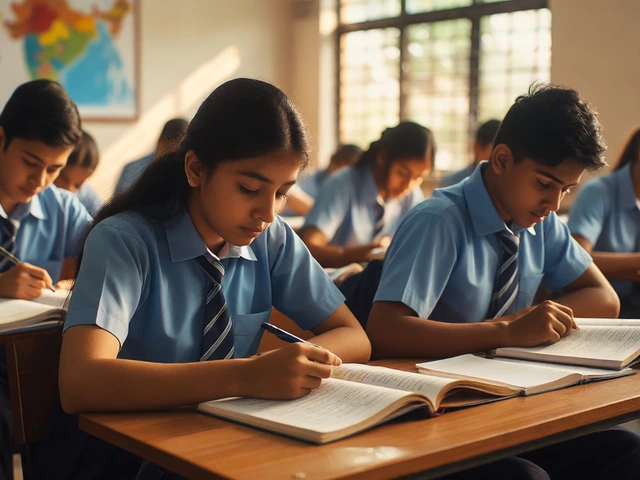

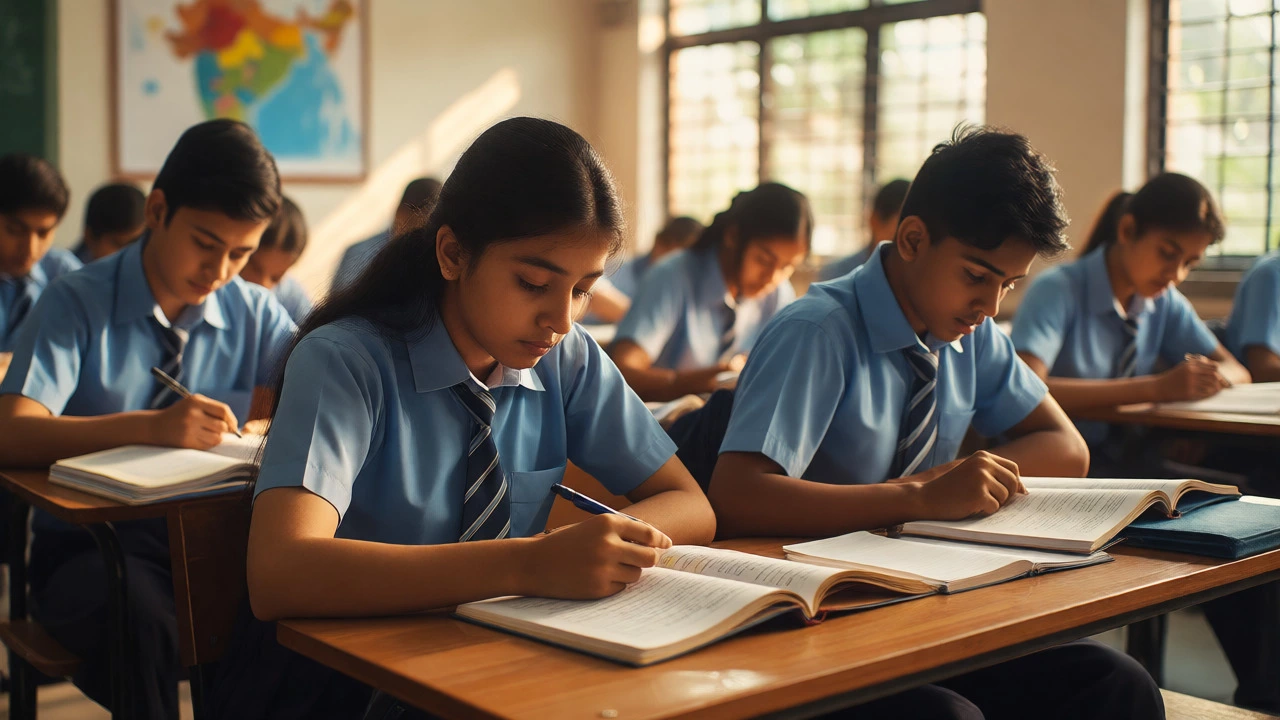
CBSE Curriculum Explorer
Navigate the Central Board of Secondary Education (CBSE) framework. Click on each stage to reveal the core focus areas, subject shifts, and critical milestones for students in Classes 1–12.
(Classes 1–5)
Focus: Curiosity & Basics
- Languages: English, Hindi/Regional
- Mathematics: Numeracy basics
- EVS: Environmental Studies
- GK: General Knowledge
(Classes 6–8)
Focus: Complexity Increase
- Science: Separated from EVS
- Social Science: History, Geo, Civics, Econ
- Computers: Optional introduction
- Assessment: Formal internal marks
(Classes 9–12)
Focus: Specialization & Boards
- Class 10: Integrated Science, Math, Soc Sci
- Class 11-12: Stream Selection (Sci/Com/Hum)
- Exams: External Board Exams
- Weightage: 70% Exam / 30% Internal
You’ve probably heard the term CBSE (Central Board of Secondary Education) thrown around at family gatherings or by neighbors whose kids are stressing over finals. But what does it actually mean? If you’re a parent trying to navigate school choices or a student wondering why your history textbook looks different from your friend’s in another state, understanding the CBSE syllabus is your first step toward clarity. It’s not just a list of topics; it’s the backbone of education for millions of students across India and abroad.
The confusion often stems from mixing up the board with the curriculum. The CBSE is the governing body that sets the standards, while the syllabus is the specific content taught in classrooms. Think of it like this: CBSE is the architect drawing the blueprints, and the syllabus is the actual building materials used to construct your knowledge base. This distinction matters because it affects everything from which textbooks you buy to how you prepare for national entrance exams like JEE and NEET.
Who Actually Runs the Show?
The Central Board of Secondary Education isn’t some private company looking for profit. It’s a government-affiliated organization established in 1952. Its primary job is to provide a uniform system of education across India. Why uniformity? Because families move. A child transferring from Delhi to Mumbai shouldn’t have to relearn math because the state board teaches fractions differently than the central one. CBSE solves that problem.
It operates under the Ministry of Education, Government of India. This gives it authority but also ties it to national educational policies. When the National Education Policy (NEP) changes, CBSE updates its framework. For instance, recent shifts emphasize competency-based learning over rote memorization. This means the syllabus isn’t static; it evolves to match what the country needs from its workforce.
Breaking Down the Structure: Classes 1 to 12
The CBSE curriculum spans twelve years, divided into three distinct phases. Each phase has a specific focus, designed to build on the previous one. You can’t skip steps here; the foundation must be solid before you add the roof.
- Primary Stage (Classes 1-5): Here, the focus is on basic literacy and numeracy. Subjects include English, Hindi (or regional language), Mathematics, Environmental Studies (EVS), and General Knowledge. There are no high-stakes exams yet. The goal is curiosity.
- Middle Stage (Classes 6-8): Complexity increases. EVS splits into Science and Social Science. Computer Science might appear as an optional subject. Assessment becomes more formal, with internal assessments playing a bigger role.
- Secondary and Senior Secondary Stages (Classes 9-12): This is where things get serious. Class 10 and 12 involve external board exams. Subject choices expand significantly, especially in Class 11 and 12, where students pick streams like Science, Commerce, or Humanities.
A common misconception is that all subjects are mandatory until Class 12. That’s false. After Class 10, specialization kicks in. You don’t need to study Physics if you’re aiming for a career in Law. The syllabus respects these diverging paths, allowing students to focus on what they’ll actually use later.
The Core Subjects: What’s Inside the Books?
If you open a standard NCERT (National Council of Educational Research and Training) textbook-the official source for most CBSE content-you’ll notice a pattern. The content is concise, clear, and aligned with competitive exam requirements. Unlike some state boards that go deep into obscure historical dates, CBSE tends to stick to conceptual clarity.
| Subject | Class 10 Focus | Class 12 Focus |
|---|---|---|
| Mathematics | Algebra, Geometry, Trigonometry basics | Calculus, Vectors, 3D Geometry, Probability |
| Science | Physics, Chemistry, Biology integrated | Separate streams: Physics, Chemistry, Biology/Computer Science |
| Social Science | History, Geography, Civics, Economics | Deep dives into Political Theory, Macroeconomics, World History |
| Languages | English Communicative, Hindi Literature/Grammar | Advanced Literature, Writing Skills, Translation |
Notice how Science changes from integrated to specialized. In Class 10, you learn about cells and electricity together. By Class 12, if you choose the Science stream, you’re doing advanced organic chemistry mechanisms and solving complex integration problems. This shift prepares you for university-level rigor.

Why NCERT Books Are Non-Negotiable
Here’s a tip that saves thousands of rupees and countless hours of stress: Stick to NCERT. Many students think they need fancy reference books from private publishers to score well. They don’t. The CBSE question papers are derived directly from NCERT textbooks. If you master those chapters, you cover 80-90% of the exam paper.
For example, in Class 12 Biology, questions on genetics often come verbatim from NCERT diagrams or examples. Deviating too early into heavy reference books like Pradeep’s or Trueman’s can lead to information overload. Use them only for extra practice after you’ve exhausted the NCERT exercises. The syllabus is designed so that the textbook alone is sufficient for passing and even scoring high distinctions.
Assessment: Exams vs. Internal Marks
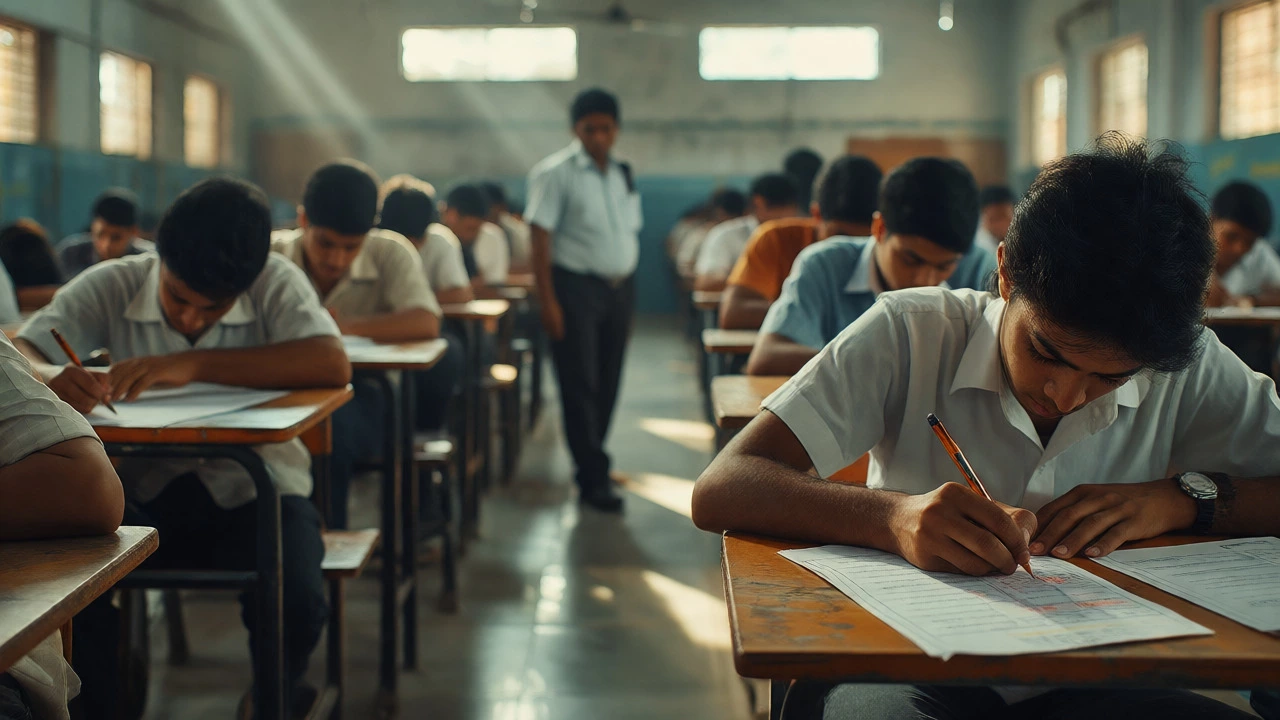
Gone are the days when your final grade depended solely on a three-hour exam in March. The current CBSE structure blends external and internal assessment. For Class 10 and 12, typically 70% of the weightage comes from the board exam, while 30% comes from internal assessments, practicals, and projects.
This change was introduced to reduce anxiety. It rewards consistent effort throughout the year, not just last-minute cramming. Practical exams in Science, for instance, test your ability to handle lab equipment, not just recite theory. Project work in Social Science requires research skills. These components are graded by your school teachers and moderated by CBSE to ensure fairness.
Also, keep an eye on the "Passing Criteria." To pass, you generally need 33% in each subject individually. Failing one subject doesn’t mean you fail the year, but you’ll have to retake that specific exam. This compartmental approach prevents a single bad day from derailing your entire academic year.
How Does This Help With Competitive Exams?
India has a fierce culture of entrance exams-JEE for engineering, NEET for medicine, CUET for universities. Why do so many parents push for CBSE? Because the CBSE syllabus aligns closely with these tests. The concepts taught in Class 11 and 12 CBSE Science and Math are the exact same foundations tested in JEE Main and Advanced.
State boards vary wildly. Some might teach calculus using different notation or omit certain topics entirely. CBSE provides a standardized baseline. If you’re planning to take national entrance exams, sticking to the CBSE path minimizes the gap between school studies and coaching classes. Your school homework becomes part of your entrance prep, rather than a separate burden.
Common Pitfalls Students Should Avoid
First, don’t ignore the "deleted chapters" list. Every year, CBSE releases a document detailing what’s included and excluded from the syllabus. Students often waste time studying topics that won’t appear in their specific year’s exam. Always download the latest syllabus PDF from the official CBSE website (cbse.gov.in).
Second, neglecting languages is a mistake. Many science students treat English or Hindi as "easy marks" and ignore them until the last week. But scoring well in languages boosts your overall percentage significantly, which matters for college admissions. Treat them with the same respect as Physics.
Third, underestimate the value of past papers. Solving the last five years’ question papers helps you understand the examiner’s mindset. You’ll see patterns-certain types of questions repeat. This isn’t cheating; it’s strategy.
Final Thoughts on Navigating the System
Understanding the CBSE syllabus isn’t just about knowing what to study. It’s about realizing that the system is designed to be predictable. Once you grasp the structure-the progression from primary to senior secondary, the reliance on NCERT, and the balance between exams and internals-you stop feeling overwhelmed. You start seeing education as a series of manageable steps rather than a chaotic mountain climb.
Whether you’re a student preparing for boards or a parent guiding your child, remember that consistency beats intensity. Study a little every day, stick to the core resources, and trust the process laid out by the board. The syllabus is your map; you just need to walk the path.
Is the CBSE syllabus the same across all schools in India?
Yes, the core academic syllabus is identical for all CBSE-affiliated schools, whether they are in India or abroad. However, individual schools may add extra-curricular activities or minor variations in teaching methodology, but the examinable content remains uniform.
Do I need to buy expensive reference books for CBSE?
No, NCERT textbooks are sufficient for mastering the CBSE syllabus. Reference books are useful for additional practice or deeper understanding but are not required to score high marks in board exams.
How often is the CBSE syllabus updated?
The syllabus is reviewed annually. Minor changes, such as deleting or adding specific chapters, happen frequently to streamline content. Major structural changes occur less often, usually tied to broader educational policy reforms like the NEP.
Can I change my subject combination in Class 11?
Generally, subject combinations are fixed at the beginning of Class 11. Changing them mid-year is difficult and depends on school policy. It’s crucial to choose wisely based on your career goals and strengths before the session starts.
What happens if I fail one subject in the CBSE board exam?
If you fail in one subject, you are eligible for a compartment exam. This allows you to retake only that specific subject without repeating the entire year. Passing this compartment exam clears your result.