



English Fluency Progress Tracker
Your Fluency Journey
Track your daily practice to build automatic English speaking skills
Daily Practice Log
Your Progress
Fluency Insights
Studies show 20 minutes daily practice improves fluency within 8 weeks
Your brain needs 21+ days to form new habits
Even 5 minutes of daily practice builds fluency
Want to speak English without thinking about grammar, without translating in your head, without freezing up when someone asks you a simple question? You’re not broken. Your brain just hasn’t been trained the right way. Most people spend years memorizing vocabulary and rules, but still can’t hold a real conversation. That’s because speaking isn’t about knowledge-it’s about wiring. Your brain needs to build new neural pathways, like learning to ride a bike. You don’t memorize balance-you practice until it becomes automatic.
Stop Learning English. Start Using It.
The biggest mistake people make is treating English like a math problem. You study verb tenses, then take a test, then forget it. Real speaking doesn’t work that way. Your brain learns language through repetition in context, not through flashcards. If you want to say, “I’ve been working here since 2022,” you need to hear it, say it, and feel it dozens of times-not just once in a textbook.
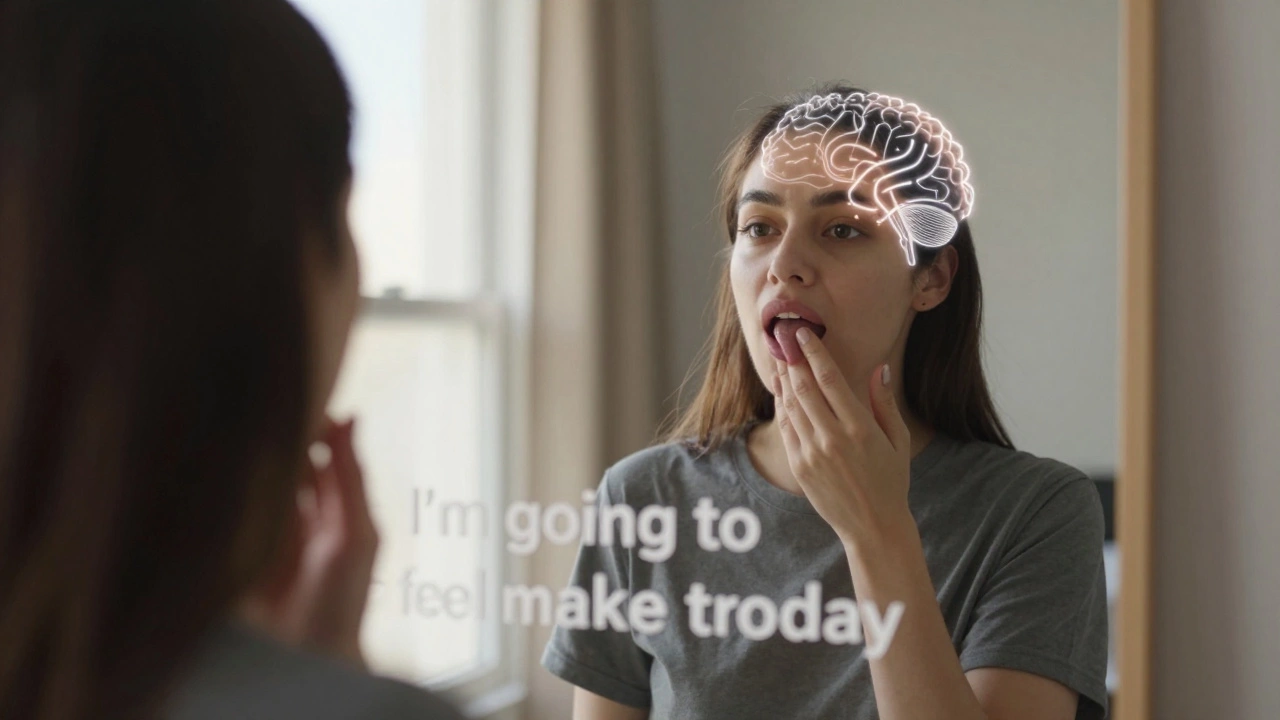
Start small. Every morning, say three things out loud before you check your phone:
- “I’m going to make coffee.”
- “I feel tired today.”
- “I need to finish this report.”
It doesn’t matter if your pronunciation isn’t perfect. What matters is that your mouth and brain are practicing the physical act of forming English sounds. This is called motor memory. Just like typing without looking at the keyboard, your tongue and lips learn the shape of English words through repetition.
Listen Like a Detective
You can’t speak well if you don’t understand how English sounds when real people say it. Textbooks teach slow, clear English. Real people mumble, cut words, and link them together. “Do you want to go?” becomes “D’ya wanna go?” If you’ve never heard that, your brain won’t recognize it when someone says it.
Start with short, clear audio-podcasts like 6-Minute English or YouTube channels like English Addict with Mr Steve. Don’t watch with subtitles. Just listen. Then listen again. Then listen while walking or washing dishes. Your brain will start picking up patterns even when you’re not trying.
Pay attention to three things:
- Where do words get cut off?
- Which syllables are stressed?
- How do people raise their voice at the end of questions?
After a week, try to repeat exactly what you heard-out loud, word for word. Don’t worry about understanding every word. Just mimic the rhythm. This is called shadowing, and it’s one of the most powerful tools for native-like fluency.
Think in English-Even When You’re Alone
When you’re walking to the store, waiting in line, or brushing your teeth-what’s going on in your head? If it’s your native language, you’re training your brain to think in that language, not English. To speak fluently, you need to switch the internal voice.
Start by narrating your day in English. Simple stuff:
- “I’m putting on my shoes.”
- “The bus is late again.”
- “I should call my mom tonight.”
Don’t translate from your native language. Think directly in English. If you don’t know a word, describe it: “the thing you use to open bottles” instead of searching for “bottle opener.” This forces your brain to build new connections instead of relying on translation.
After a few weeks, try thinking in full sentences about your feelings: “I’m a little nervous about tomorrow’s meeting,” or “This coffee tastes better than yesterday’s.” The more you think in English, the less you’ll need to pause and translate when speaking.

Speak Even When You’re Afraid
Fear is the biggest blocker. You’re scared of sounding stupid. You’re scared of making mistakes. But here’s the truth: every native speaker makes mistakes. They say “I seen it” instead of “I saw it.” They mix up “there,” “their,” and “they’re.” The difference is, they don’t stop talking.
Find one safe space to practice speaking every day. It could be:
- A language exchange app like Tandem or HelloTalk
- A local English meetup group
- A 10-minute Zoom call with a tutor
Set one goal: say five full sentences without switching to your native language. That’s it. Don’t aim for perfection. Aim for persistence. Every time you speak, even badly, you’re strengthening your brain’s ability to produce English on the fly.
After your first few tries, you’ll notice something: people don’t laugh. They don’t judge. They’re just happy you’re trying. Most of them have struggled with a second language too.
Use Your Body to Lock In English
Language isn’t just in your head-it’s in your body. Your posture, your gestures, your breathing all affect how you speak. When you’re nervous, you tense up. That makes your voice shaky, your words rushed, your pronunciation unclear.
Try this: before you speak, take a slow breath in through your nose, hold for two seconds, then exhale through your mouth. Now speak. You’ll notice your voice sounds calmer, clearer, and more confident.
Also, use hand gestures. When you say “I was really tired,” drop your shoulders. When you say “It’s so big!” spread your arms. Your body helps your brain access the right words faster. This is called embodied cognition-and it’s why kids learn languages faster than adults. They move while they talk.

Track Progress, Not Perfection
You won’t wake up one day speaking like a native. But you will notice small wins:
- You understood a joke in a movie without subtitles.
- You asked for directions and got the right answer.
- You corrected yourself mid-sentence-and kept going.
Write these down in a notebook or voice memo. Review them every week. This isn’t about grades. It’s about proof that your brain is changing.
Studies from the University of Edinburgh show that people who practice speaking daily for just 20 minutes see measurable improvements in fluency within 8 weeks. Not because they became perfect. But because they kept going.
What to Avoid
Don’t wait for “perfect” grammar. Don’t memorize long lists of vocabulary. Don’t rely on apps that quiz you on random words. These methods feel productive, but they don’t build speaking skills.
Also, avoid translating everything in your head. If you think “I want to say ‘I’m hungry’ in English,” you’re slowing yourself down. Train your brain to go straight from thought to English.
And don’t compare yourself to others. Some people learn fast. Others take longer. It doesn’t matter. What matters is that you show up every day-even if it’s just for five minutes.
One Simple Rule to Follow
Speak before you’re ready.
That’s it. Not tomorrow. Not when you know more words. Not when your accent improves. Now. Say something-even if it’s awkward. Say it again tomorrow. And the day after. Your brain doesn’t learn from perfection. It learns from repetition, from effort, from showing up even when you’re scared.
Fluency isn’t a destination. It’s a habit. And habits are built one small, messy, real conversation at a time.
How long does it take to speak English fluently?
There’s no fixed timeline-it depends on how much you practice, not how long you’ve studied. Most people who speak 20-30 minutes daily see clear progress in 8 to 12 weeks. Fluency means you can think and respond without translating, not that you sound like a native. That’s achievable in a few months with consistent speaking practice.
Should I focus on grammar or speaking first?
Speak first, fix grammar later. Grammar matters for writing, but not for speaking. Native speakers don’t think about subject-verb agreement while chatting. They say what feels right. Focus on getting your message across. You’ll naturally correct mistakes over time by hearing correct usage. Don’t let grammar hold you back from speaking.
Is it better to practice with native speakers or other learners?
Both help, but for different reasons. Native speakers give you real pronunciation, slang, and natural flow. Other learners help you feel less alone and give you space to make mistakes without pressure. Start with fellow learners if you’re nervous. Once you’re more comfortable, seek out native speakers. The goal is exposure to real language, not perfection.
Can I learn to speak English without living in an English-speaking country?
Absolutely. Thousands of people speak fluent English without ever leaving their home country. What matters is immersion-not location. Fill your day with English: podcasts, movies, thinking out loud, speaking with online partners. Create your own English environment. You don’t need to move-you just need to act like you’re already there.
Why do I understand English but can’t speak it?
Because listening and speaking use different parts of your brain. You’ve trained your brain to understand English through reading and listening, but you haven’t trained the speaking muscles. It’s like knowing how to swim by watching videos but never getting in the water. You need to practice producing the language-not just receiving it.