




Find Your First Programming Language
Answer these questions to discover which language aligns best with your learning style and career goals.
You’re staring at a screen full of syntax errors, wondering if you picked the wrong path. Maybe you started with C++ because it sounded impressive, only to realize you spent three weeks debugging memory leaks instead of building anything cool. Or perhaps you jumped into Java and got stuck in the bureaucratic maze of object-oriented boilerplate before writing a single line of useful code. This is the classic beginner’s paralysis: what code should I learn first?
Here’s the truth nobody tells you upfront: there is no single "best" language. But there is definitely a worst choice for your specific goals. Choosing the wrong first language doesn’t just waste time; it kills motivation. You want to build things, not fight compilers. So, let’s cut through the noise and figure out exactly which programming language fits your brain, your career goals, and your patience levels.
Why Your First Language Matters More Than You Think
Think of learning to code like learning to drive. If you start on a manual transmission truck in heavy city traffic, you might quit before you even get to the highway. If you start on an automatic sedan, you focus on the road, the signs, and the destination. Your first programming language is that vehicle. It shapes how you think about problems.
When you pick a language, you aren't just memorizing keywords. You are adopting a philosophy. Some languages force you to manage every byte of memory (like C is a general-purpose computer programming language that supports low-level memory access). Others handle it for you so you can focus on logic (Python is a high-level, general-purpose programming language emphasizing code readability). Once you learn one way, unlearning it is hard. That’s why starting with something forgiving yet powerful is crucial.
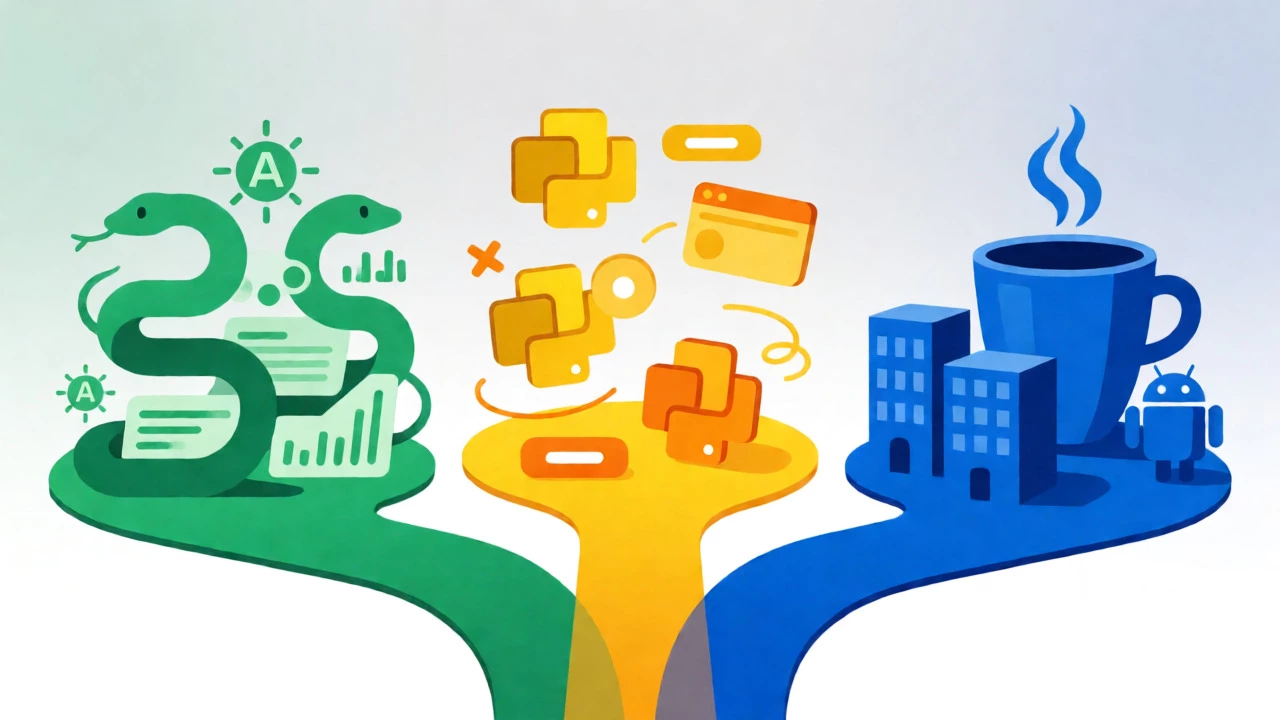
The Big Three: Python, JavaScript, or Java?
Most beginners narrow it down to these three. Let’s break them down based on what you actually want to do.
Python: The Friendly Giant
If you have zero experience and want to see results fast, Python is almost always the right answer. Why? Because it reads like English. You don’t need semicolons at the end of every line. You don’t need to declare variable types explicitly. You can write a script that scrapes data from a website or automates a boring Excel task in twenty lines of code.
Python dominates in data science, machine learning, and automation. If you’re interested in AI, finance, or analyzing trends, this is your gateway. The community support is massive, meaning if you hit an error, someone has already posted the solution on Stack Overflow. However, Python is slower than compiled languages. For a beginner, though, speed of execution matters less than speed of learning.
JavaScript: The Web’s Native Tongue
Do you want to build websites? Not just static pages, but interactive apps where buttons click, animations move, and data updates without reloading? Then you must learn JavaScript is a lightweight, interpreted, or just-in-time compiled programming language with first-class functions. It is the only language that runs natively in every web browser.
Unlike Python, JavaScript gives you immediate visual feedback. You change a color in the code, refresh the page, and boom-the button turns blue. This instant gratification loop keeps beginners engaged. But beware: JavaScript has quirks. Its handling of asynchronous operations (promises, async/await) can confuse newcomers. Still, if your dream is to be a front-end developer or build mobile apps using frameworks like React Native, JavaScript is non-negotiable.
Java: The Corporate Workhorse
Java is verbose. You’ll write more lines of code to do simple things compared to Python. But it teaches you strict discipline. It forces you to understand types, objects, and structure. Many large companies use Java for their backend systems. If you aim for a stable job in enterprise software development, banking, or Android app development (though Kotlin is rising here), Java is a solid foundation.
| Feature | Python | JavaScript | Java |
|---|---|---|---|
| Learning Curve | Very Gentle | Moderate | Steep |
| Primary Use Case | Data Science, Automation, AI | Web Development, Mobile Apps | Enterprise Systems, Android |
| Job Market Demand | High (Growing) | Extremely High | Stable & High |
| Feedback Loop | Console Output | Visual Browser Update | Compile then Run |
Don’t Ignore HTML and CSS
Wait, those aren’t programming languages! Technically, correct. They are markup and style sheet languages. But if you want to build websites, you cannot skip them. Trying to learn JavaScript without knowing how to structure a page (HTML) or style it (CSS) is like trying to paint a house before you’ve built the walls.
Spend two weekends learning basic HTML tags (<div>, <p>, <a>) and CSS properties (colors, fonts, layout). Then dive into JavaScript. This trio-HTML, CSS, JS-is often called the "Holy Trinity" of web development. Mastering them gets you employable faster than struggling through complex algorithms in isolation.
How to Choose Based on Your Personality
Are you impatient? Do you hate reading long documentation? Pick Python. Are you visual? Do you need to see changes immediately? Pick JavaScript. Are you methodical? Do you like rules and structure? Pick Java or C#.
Consider your background too. If you come from a math or statistics background, Python feels natural. If you’re a designer who thinks in pixels and layouts, JavaScript will feel intuitive. There’s no shame in picking the path of least resistance. Motivation is your scarcest resource when learning to code. Protect it by choosing a language that aligns with your interests.
The Myth of "Just One Language"
Here’s a secret experienced developers know: the second language is easier. Once you understand variables, loops, conditionals, and functions in one language, you recognize those concepts everywhere. Learning Python teaches you logic. Learning JavaScript teaches you event-driven programming. They complement each other.
Don’t fall into the trap of thinking you must master one language perfectly before touching another. Aim for competence, not perfection. Build small projects. A calculator. A to-do list. A weather app. These tiny wins build confidence. When you get stuck-and you will-don’t switch languages. Debug. Search. Ask. That struggle is where learning happens.

Practical Steps to Start Today
- Pick one goal: "I want to automate my spreadsheets" or "I want to make a personal blog." Don’t say "I want to be a programmer." Be specific.
- Choose the tool for the goal: Spreadsheets? Python. Blog? HTML/CSS/JS.
- Find a structured course: Random YouTube tutorials lead to confusion. Look for coding classes that offer project-based learning. In Auckland, local bootcamps and online platforms like Coursera or Udemy provide structured paths.
- Code every day: Even 15 minutes. Consistency beats intensity. A muscle grows with daily exercise, not one weekly marathon.
- Build something ugly: Your first app won’t look pretty. That’s fine. Make it work. Then make it pretty later.
Common Pitfalls to Avoid
First, tutorial hell. This is when you watch endless videos but never write code yourself. You feel productive, but you’re passive. Stop watching after 20 minutes. Start typing. Break things. Fix them.
Second, comparing yourself to others. Someone online might say they learned Rust in a week. Great for them. You’re learning fundamentals. Speed isn’t the metric; understanding is.
Third, ignoring version control. Learn Git early. It saves your skin when you accidentally delete half your code. It’s not glamorous, but it’s professional.
Ultimately, the best code to learn first is the one that lets you build something you care about. Whether it’s Python for data, JavaScript for web, or Swift for iOS, start today. The syntax will stick. The logic will deepen. And soon, you won’t be asking "what code should I learn first?" You’ll be asking "what feature should I add next?"
Is Python better than JavaScript for beginners?
Generally, yes, Python is considered easier for absolute beginners due to its simple syntax and lack of complex setup requirements. However, if your goal is strictly web development, JavaScript is essential because it runs directly in the browser, providing immediate visual feedback which can be highly motivating.
Can I learn two coding languages at once?
It is usually recommended to focus on one language until you grasp core concepts like loops, variables, and functions. Switching between syntaxes too early can cause confusion. Once you are comfortable with one, adding a second becomes significantly easier as many concepts transfer over.
Do I need a computer science degree to learn coding?
No. Many successful developers are self-taught or completed bootcamps. While a CS degree provides deep theoretical knowledge, practical skills are often learned through building projects and taking targeted coding classes. Employers increasingly value portfolios and problem-solving abilities over formal degrees.
Which language pays the most?
Salaries vary by location and role. Generally, specialized languages like Scala, Go, or Rust command higher salaries due to scarcity of experts. However, common languages like Python, Java, and JavaScript have vast job markets, offering more entry-level opportunities. Focus on mastering fundamentals first; specialization comes later.
How long does it take to learn a coding language?
To become proficient enough to build basic applications, expect 3-6 months of consistent study (10-15 hours per week). Mastery takes years. The key is consistency rather than duration. Short, daily practice sessions yield better retention than sporadic weekend marathons.