



E-Learning Engagement Assessment Tool
How Engaged Are You?
Answer these questions to assess your current engagement level in online courses.
What You Need to Know
Your engagement score shows how likely you are to complete online courses. The higher the score, the more likely you are to finish your courses.
How to Improve Your Engagement
Based on your score, here are the most impactful community features that could help you complete more courses:
The biggest problem with e-learning isn’t the technology. It’s not the lack of videos, apps, or interactive quizzes. It’s not even the cost. The real issue is something quieter, more persistent, and harder to fix: student disengagement.
Why E-Learning Feels Like a Solo Marathon
When you sign up for an online course, you’re handed a login, a syllabus, and a to-do list. Then you’re left alone. No one checks in. No one notices if you miss a week. No one asks how you’re doing. That’s not learning-it’s self-punishment disguised as education.Think about the last time you tried to learn something new on your own. Maybe it was a language app, a coding tutorial, or a fitness plan. How many days did you stick with it before the motivation faded? Now multiply that by hundreds of students, each staring at a screen in a quiet room, wondering if anyone even cares they’re there.
Studies from the University of Pennsylvania show that completion rates for MOOCs hover around 5% to 15%. That means 85 out of every 100 people who start an online course never finish it. Not because the content is too hard. Not because they’re lazy. Because they’re isolated.
Learning Is Social-But E-Learning Isn’t
Humans didn’t evolve to learn in silence. We learned by watching, asking, arguing, and failing together. Ancient apprenticeships, medieval guilds, even traditional classrooms-all thrived on human connection.E-learning platforms, however, treat students like data points. They track clicks, quiz scores, and time spent. But they don’t track loneliness. They don’t measure frustration. They don’t notice when someone stops watching videos after Lesson 3, not because they got it, but because they gave up.
Compare that to a physical classroom. If a student looks lost, the teacher notices. If someone’s quiet for days, the classmate next to them asks if they’re okay. In e-learning, silence is ignored. And silence kills motivation.
Design Flaws That Make Disengagement Worse
Most e-learning platforms are built like software products-not learning environments. They prioritize features over human needs.- Automated progress bars that make you feel like you’re winning, even when you’re not learning.
- Pre-recorded lectures that can’t answer your questions.
- Forums that are ghost towns, with replies from bots or strangers who don’t know your name.
- Deadlines that feel arbitrary because no one’s holding you accountable.
Some platforms try to fix this with badges, leaderboards, or gamified points. But those tricks only work for a small group-usually the already motivated. For everyone else, they feel performative. Like you’re playing a game no one else is even watching.
Real engagement doesn’t come from points. It comes from belonging. From knowing someone sees your effort, even when you’re stuck.
The Illusion of Flexibility
E-learning sells itself on flexibility: learn anytime, anywhere. But that’s also its trap.When you can start anytime, you start never. When there’s no fixed schedule, procrastination wins. Without the structure of class times, group projects, or office hours, motivation has to come entirely from within-and most people don’t have that kind of discipline.
Take someone trying to learn data analysis while working a full-time job. They think, “I’ll do it after dinner.” But after dinner, they’re tired. Then they tell themselves they’ll do it tomorrow. And tomorrow becomes next week. And next week becomes never.
Flexibility sounds great until it’s the only thing holding you up.
What Actually Works
There are exceptions. Some platforms are fixing this. Not with flashy tech, but with simple human touches.Think about platforms like Coursera’s Guided Projects or Udacity’s Mentorship Tracks. They don’t just give you videos. They pair you with a real person who reviews your work, gives feedback, and checks in every week. That’s it. One human connection increases completion rates by over 60%.
Another example: small cohort-based courses. Groups of 10-20 people who start and finish together. They meet weekly on Zoom. They share struggles. They celebrate wins. They become a team. That’s not e-learning. That’s learning-with people.
Even in corporate training, companies that add peer accountability-like weekly check-ins with a buddy-see 3x higher completion rates than those relying on solo modules.

The Way Forward Isn’t More Tech. It’s More Humanity.
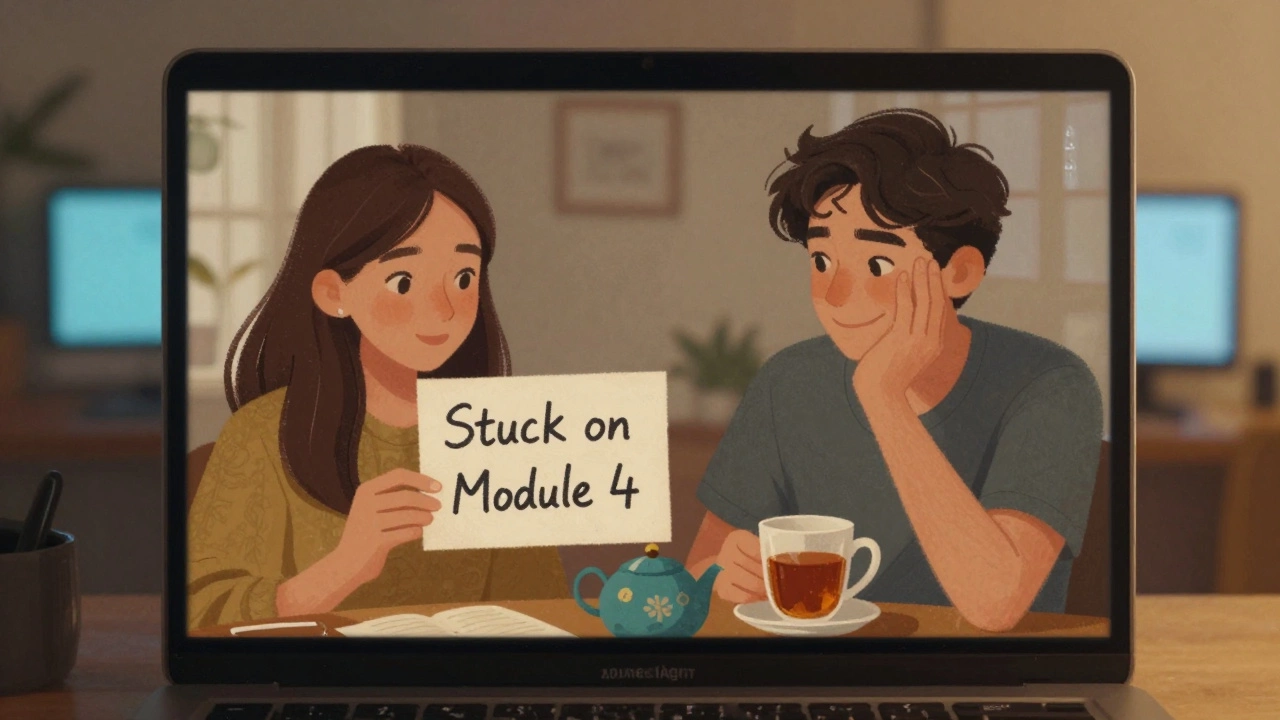
The future of e-learning doesn’t need AI tutors or VR classrooms. It needs more empathy.What if every course had a live, weekly Q&A with the instructor? What if students were grouped into small teams that had to submit assignments together? What if every learner got a personal progress note from a real person every two weeks-not a robot saying “Great job!” but someone who said, “I noticed you struggled with module 4. Want to talk about it?”
Technology can scale content. But only humans can scale care.
The biggest problem with e-learning isn’t the platform. It’s that we built platforms to replace human connection-and then wondered why people quit.
It’s Not About the Course. It’s About the Community.
If you’re building or choosing an e-learning platform, ask this: “Does this make students feel less alone?”If the answer is no, then no matter how polished the UI, how many certificates it offers, or how many celebrities are in the videos-it’s not working.
Learning isn’t a solo journey. It never was. And pretending it is, is why so many people walk away.
Why do most people quit online courses?
Most people quit because they feel isolated. Online courses often lack human interaction, accountability, and emotional support. Without someone noticing your progress-or lack of it-it’s easy to lose motivation. Studies show completion rates are under 15% for most MOOCs, not because the content is bad, but because learners feel abandoned.
Is poor video quality the main issue with e-learning?
No. While poor audio or lagging videos can be frustrating, they’re surface-level problems. People tolerate low-quality videos if they feel connected. The real issue is the absence of feedback, community, and personal encouragement. A low-res video with a live mentor is more effective than a 4K lecture with no one to ask questions to.
Do gamification features like badges help with engagement?
They help a little-for a small group. People who are already self-driven enjoy badges and points. But for the majority, especially those struggling or feeling overwhelmed, gamification feels fake. It doesn’t replace real human feedback. A badge won’t tell you why you’re stuck. A mentor will.
Can AI solve the engagement problem in e-learning?
AI can personalize content and flag drop-offs, but it can’t build trust or offer emotional support. Chatbots can answer “What’s the next lesson?” but they can’t say, “I see you’ve been quiet. Want to talk about what’s holding you back?” That kind of care still needs a human.
What’s the difference between e-learning and traditional learning?
Traditional learning has built-in social structures: class times, group work, office hours, peer pressure to show up. E-learning removes those structures and replaces them with convenience. The trade-off is accountability. Without those structures, most learners don’t have the discipline to stay on track without external support.
Are there any e-learning platforms doing this right?
Yes. Platforms like Coursera’s Guided Projects, Udacity’s Mentorship Tracks, and cohort-based courses from platforms like Outschool or Maven pair learners with real humans-mentors, coaches, or peers-who provide feedback and check-ins. These programs see completion rates above 60%, proving that human connection, not tech, is the key.